


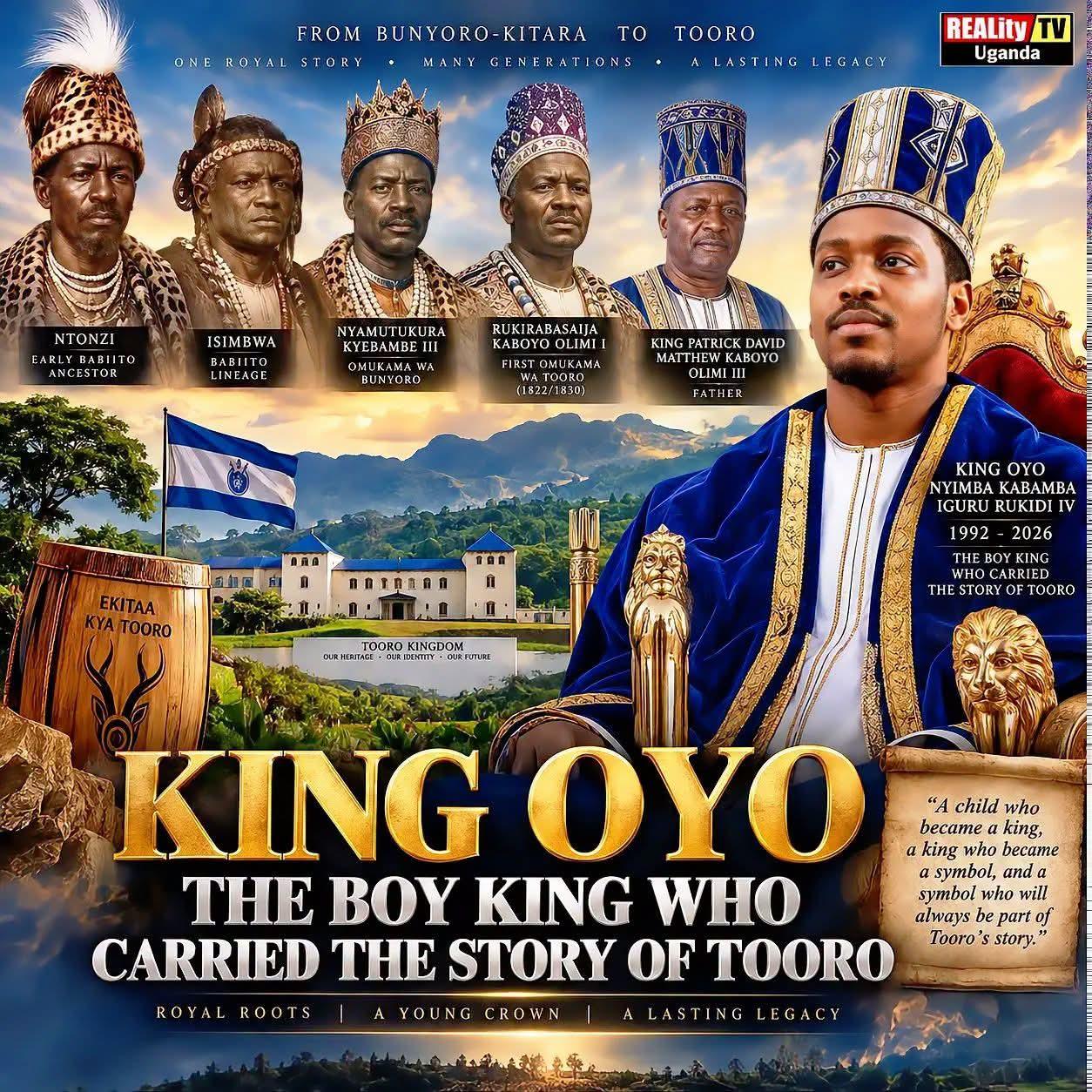
To understand the life of the late King Oyo Nyimba Kabamba Iguru Rukidi IV, one must first understand the long royal story from which Tooro itself emerged. The history of Tooro is deeply connected to the ancient Bunyoro-Kitara tradition, and according to royal traditions, the Babiito dynasty stretches across generations of rulers, migrations, succession struggles and the creation of new kingdoms. In this long story, Tooro was not simply born as another kingdom; it emerged from a royal family that had grown powerful enough to produce new branches.
The commonly documented history places the foundation of an independent Tooro in the early 19th century. Prince Rukirabasaija Kaboyo Omuhundwa Kasusunkwanzi Olimi I, the eldest son of Bunyoro's Omukama Nyamutukura Kyebambe III, broke away and established his own kingdom. Royal tradition places this separation around 1822, while historical accounts commonly date the establishment of Tooro as an independent kingdom around 1830. Kaboyo became the first Omukama of Tooro, creating a royal house whose descendants would eventually lead the kingdom for generations.
And this is where the story becomes more than a political history. Across the Great Lakes region, oral traditions tell of royal families spreading through migration, marriage and succession. Bunyoro, Tooro and Busoga are remembered within traditions that connect their royal institutions to the wider Babiito story. Whether every detail of those traditions can be established historically or not, they remain important because they explain how communities understand their shared ancestry, royal customs, drums, clans and institutions.
But perhaps the most remarkable chapter in that centuries-old story was written in 1995.
On April 16, 1992, a prince named Oyo Nyimba Kabamba Iguru Rukidi was born into the Tooro royal family. His father was King Patrick David Matthew Kaboyo Olimi III, and his mother was Queen Best Kemigisa. Then, on August 26, 1995, tragedy struck the kingdom when his father died. Suddenly, the three-year-old prince became heir to one of Uganda's most historic traditional kingdoms. On September 12, 1995, little Oyo ascended the Tooro throne. At just three years old, he became the world's youngest reigning monarch.
Imagine that moment. A child who was still at an age when most children were learning how to read, play and understand the world was suddenly carrying the weight of a centuries-old institution. He could not govern in the ordinary sense of an adult monarch, and therefore members of the royal family, guardians and regents helped manage the affairs of the kingdom while he grew up. Yet his name had already travelled far beyond the hills of Fort Portal. Oyo was no longer simply a child; he had become a symbol of Tooro itself.
For the next three decades, his life became intertwined with the modern history of the kingdom. He grew from the famous “boy king” into an adult monarch, formally receiving the full responsibilities of the crown as he reached adulthood. His 18th-birthday coronation in 2010 became another defining moment, transforming the image of the little prince known around the world into that of a young king assuming his place within Tooro's royal tradition.
King Oyo's significance, however, was never limited to the title of “world's youngest monarch.” As an adult, he increasingly represented a bridge between tradition and the younger generation. His public role included support for youth empowerment, education and environmental causes, while the kingdom under his leadership also promoted longer-term development ambitions. In a country where traditional kingdoms have cultural rather than sovereign political authority, Oyo's influence rested largely on identity, heritage, community and the ability of the monarchy to remain relevant to a changing generation.
Then, after more than three decades on the throne, the story suddenly came to an end. On August 27, 2026, Tooro Kingdom announced that King Oyo had died at approximately 10 pm. while receiving medical treatment in the United States. He was 34 years old. His death shocked Uganda because many people had grown up knowing him not simply as a king, but as the little monarch whose extraordinary childhood had made Tooro famous across the world.
Today, when the people of Tooro mourn King Oyo, they are mourning more than an individual. They are mourning a chapter in a royal story that stretches back generations. From the ancient traditions associated with Bunyoro-Kitara, through the emergence of Tooro under Prince Kaboyo, through the restoration of traditional kingdoms in Uganda, and finally to a three-year-old boy who inherited the crown in 1995, Oyo's life became one of the most extraordinary journeys in African royalty.
Perhaps that is the most fitting way to remember him: King Oyo was born into a dynasty, crowned as a child, raised under the weight of history and died as a young man who had spent almost his entire life carrying a crown. The little boy who once captured the world's attention became the face of Tooro for more than 30 years. And now, as the kingdom enters another chapter, the question is no longer how young its king was when he ascended the throne, but what legacy the man he became has left behind.
The commonly documented history places the foundation of an independent Tooro in the early 19th century. Prince Rukirabasaija Kaboyo Omuhundwa Kasusunkwanzi Olimi I, the eldest son of Bunyoro's Omukama Nyamutukura Kyebambe III, broke away and established his own kingdom. Royal tradition places this separation around 1822, while historical accounts commonly date the establishment of Tooro as an independent kingdom around 1830. Kaboyo became the first Omukama of Tooro, creating a royal house whose descendants would eventually lead the kingdom for generations.
And this is where the story becomes more than a political history. Across the Great Lakes region, oral traditions tell of royal families spreading through migration, marriage and succession. Bunyoro, Tooro and Busoga are remembered within traditions that connect their royal institutions to the wider Babiito story. Whether every detail of those traditions can be established historically or not, they remain important because they explain how communities understand their shared ancestry, royal customs, drums, clans and institutions.
But perhaps the most remarkable chapter in that centuries-old story was written in 1995.
On April 16, 1992, a prince named Oyo Nyimba Kabamba Iguru Rukidi was born into the Tooro royal family. His father was King Patrick David Matthew Kaboyo Olimi III, and his mother was Queen Best Kemigisa. Then, on August 26, 1995, tragedy struck the kingdom when his father died. Suddenly, the three-year-old prince became heir to one of Uganda's most historic traditional kingdoms. On September 12, 1995, little Oyo ascended the Tooro throne. At just three years old, he became the world's youngest reigning monarch.
Imagine that moment. A child who was still at an age when most children were learning how to read, play and understand the world was suddenly carrying the weight of a centuries-old institution. He could not govern in the ordinary sense of an adult monarch, and therefore members of the royal family, guardians and regents helped manage the affairs of the kingdom while he grew up. Yet his name had already travelled far beyond the hills of Fort Portal. Oyo was no longer simply a child; he had become a symbol of Tooro itself.
For the next three decades, his life became intertwined with the modern history of the kingdom. He grew from the famous “boy king” into an adult monarch, formally receiving the full responsibilities of the crown as he reached adulthood. His 18th-birthday coronation in 2010 became another defining moment, transforming the image of the little prince known around the world into that of a young king assuming his place within Tooro's royal tradition.
King Oyo's significance, however, was never limited to the title of “world's youngest monarch.” As an adult, he increasingly represented a bridge between tradition and the younger generation. His public role included support for youth empowerment, education and environmental causes, while the kingdom under his leadership also promoted longer-term development ambitions. In a country where traditional kingdoms have cultural rather than sovereign political authority, Oyo's influence rested largely on identity, heritage, community and the ability of the monarchy to remain relevant to a changing generation.
Then, after more than three decades on the throne, the story suddenly came to an end. On August 27, 2026, Tooro Kingdom announced that King Oyo had died at approximately 10 pm. while receiving medical treatment in the United States. He was 34 years old. His death shocked Uganda because many people had grown up knowing him not simply as a king, but as the little monarch whose extraordinary childhood had made Tooro famous across the world.
Today, when the people of Tooro mourn King Oyo, they are mourning more than an individual. They are mourning a chapter in a royal story that stretches back generations. From the ancient traditions associated with Bunyoro-Kitara, through the emergence of Tooro under Prince Kaboyo, through the restoration of traditional kingdoms in Uganda, and finally to a three-year-old boy who inherited the crown in 1995, Oyo's life became one of the most extraordinary journeys in African royalty.
Perhaps that is the most fitting way to remember him: King Oyo was born into a dynasty, crowned as a child, raised under the weight of history and died as a young man who had spent almost his entire life carrying a crown. The little boy who once captured the world's attention became the face of Tooro for more than 30 years. And now, as the kingdom enters another chapter, the question is no longer how young its king was when he ascended the throne, but what legacy the man he became has left behind.
To understand the life of the late King Oyo Nyimba Kabamba Iguru Rukidi IV, one must first understand the long royal story from which Tooro itself emerged. The history of Tooro is deeply connected to the ancient Bunyoro-Kitara tradition, and according to royal traditions, the Babiito dynasty stretches across generations of rulers, migrations, succession struggles and the creation of new kingdoms. In this long story, Tooro was not simply born as another kingdom; it emerged from a royal family that had grown powerful enough to produce new branches.
The commonly documented history places the foundation of an independent Tooro in the early 19th century. Prince Rukirabasaija Kaboyo Omuhundwa Kasusunkwanzi Olimi I, the eldest son of Bunyoro's Omukama Nyamutukura Kyebambe III, broke away and established his own kingdom. Royal tradition places this separation around 1822, while historical accounts commonly date the establishment of Tooro as an independent kingdom around 1830. Kaboyo became the first Omukama of Tooro, creating a royal house whose descendants would eventually lead the kingdom for generations.
And this is where the story becomes more than a political history. Across the Great Lakes region, oral traditions tell of royal families spreading through migration, marriage and succession. Bunyoro, Tooro and Busoga are remembered within traditions that connect their royal institutions to the wider Babiito story. Whether every detail of those traditions can be established historically or not, they remain important because they explain how communities understand their shared ancestry, royal customs, drums, clans and institutions.
But perhaps the most remarkable chapter in that centuries-old story was written in 1995.
On April 16, 1992, a prince named Oyo Nyimba Kabamba Iguru Rukidi was born into the Tooro royal family. His father was King Patrick David Matthew Kaboyo Olimi III, and his mother was Queen Best Kemigisa. Then, on August 26, 1995, tragedy struck the kingdom when his father died. Suddenly, the three-year-old prince became heir to one of Uganda's most historic traditional kingdoms. On September 12, 1995, little Oyo ascended the Tooro throne. At just three years old, he became the world's youngest reigning monarch.
Imagine that moment. A child who was still at an age when most children were learning how to read, play and understand the world was suddenly carrying the weight of a centuries-old institution. He could not govern in the ordinary sense of an adult monarch, and therefore members of the royal family, guardians and regents helped manage the affairs of the kingdom while he grew up. Yet his name had already travelled far beyond the hills of Fort Portal. Oyo was no longer simply a child; he had become a symbol of Tooro itself.
For the next three decades, his life became intertwined with the modern history of the kingdom. He grew from the famous “boy king” into an adult monarch, formally receiving the full responsibilities of the crown as he reached adulthood. His 18th-birthday coronation in 2010 became another defining moment, transforming the image of the little prince known around the world into that of a young king assuming his place within Tooro's royal tradition.
King Oyo's significance, however, was never limited to the title of “world's youngest monarch.” As an adult, he increasingly represented a bridge between tradition and the younger generation. His public role included support for youth empowerment, education and environmental causes, while the kingdom under his leadership also promoted longer-term development ambitions. In a country where traditional kingdoms have cultural rather than sovereign political authority, Oyo's influence rested largely on identity, heritage, community and the ability of the monarchy to remain relevant to a changing generation.
Then, after more than three decades on the throne, the story suddenly came to an end. On August 27, 2026, Tooro Kingdom announced that King Oyo had died at approximately 10 pm. while receiving medical treatment in the United States. He was 34 years old. His death shocked Uganda because many people had grown up knowing him not simply as a king, but as the little monarch whose extraordinary childhood had made Tooro famous across the world.
Today, when the people of Tooro mourn King Oyo, they are mourning more than an individual. They are mourning a chapter in a royal story that stretches back generations. From the ancient traditions associated with Bunyoro-Kitara, through the emergence of Tooro under Prince Kaboyo, through the restoration of traditional kingdoms in Uganda, and finally to a three-year-old boy who inherited the crown in 1995, Oyo's life became one of the most extraordinary journeys in African royalty.
Perhaps that is the most fitting way to remember him: King Oyo was born into a dynasty, crowned as a child, raised under the weight of history and died as a young man who had spent almost his entire life carrying a crown. The little boy who once captured the world's attention became the face of Tooro for more than 30 years. And now, as the kingdom enters another chapter, the question is no longer how young its king was when he ascended the throne, but what legacy the man he became has left behind.

 English
 Arabic
 French
 Spanish
 Portuguese
 Turkish
 Dutch
Dutch
 Italiano
 Russian
 Romaian
 Portuguese (Brazil)
 Greek
Greek