


You've done the reading. The references are in, the sections are written, and nothing obvious is missing. Then you read the draft from top to bottom and it doesn't hold together.
The introduction sets up a clear question, but the discussion gradually drifts towards points that don't answer it. By the conclusion, the argument has lost its direction.
It's frustrating because every paragraph seems reasonable on its own. The problem only shows when you look at how the sections work together.
Most people respond by polishing sentences. That rarely helps. The trouble is usually where your material sits and what you've asked it to do, not how it's phrased.
The good news: you almost never need to start again.
Why a finished draft still feels scattered
You write one paragraph at a time, so your attention keeps moving forward. It's easy to miss that section three has drifted away from section one.
Consider a report on leadership styles and employee performance. It might cover transformational leadership, motivation and organisational culture, each well researched. The difficulty begins when they stay separate. Unless the report explains how leadership shapes motivation, and how culture affects that link, the reader gets several topics rather than one argument.
Expectations also shift with the level of study. At Levels 4 to 6, you generally need to show you understand concepts and can apply them. At Level 7, the work usually calls for more independent judgement and a clearer view of the limits of existing research. Your module's marking criteria always have the final say.
A good assignment doesn't just contain the right information. It shows why that information matters.
Four problems that weaken a strong draft
1. Too much research. One source gives a useful definition, another a fresh perspective, a third an interesting example. Each is relevant to the subject, but that doesn't make it useful to your argument. Material that doesn't help answer the question makes the work longer, not stronger.
2. Repetition. A theory explained in the literature review often gets explained again in the discussion. Usually a brief reference is enough. Ask whether the second mention develops the idea, by applying or comparing it, or just restates what the reader already knows.
3. Awkward order. A case study jumps from falling staff satisfaction to recruitment costs, then back to management behaviour. They may all be linked, but you haven't shown the reader how.
4. Description where evaluation was asked for. Pages explain what a theory says, and barely a paragraph asks whether it works. It's easy to miss because a clear explanation can look like depth. The reader learns what the theory claims, but not whether the evidence supports it.
Which kind of help does your draft need?
Editing happens at different levels, and they don't solve the same problems. A coursework editing service might offer proofreading, structural editing or argument review, depending on its scope. Proofreading corrects language and presentation. Structural editing looks at the order of ideas. Argument review checks whether claims are backed by suitable evidence.
It's tempting to focus on grammar when the real issue is structure. Correcting sentences can't rescue an unsupported conclusion, and moving paragraphs can't make up for thin analysis. Name the problem first, then spend your time on the fix that matters.
Why "however" won't save you
Coherence is the overall logic of the piece. Cohesion is the stitching between sentences and paragraphs.
Words like "therefore" and "in addition" help readers follow the link between sentences. They can't create a link the argument doesn't have. If a paragraph introduces an idea with little connection to what came before, a transition won't explain why it belongs there.
Explaining a motivation theory is a necessary starting point, but for an evaluative task it isn't enough. You also need to ask how well it explains the situation, compare it with other interpretations and consider where its assumptions may not hold. That's where description becomes analysis.
The two-highlighter check
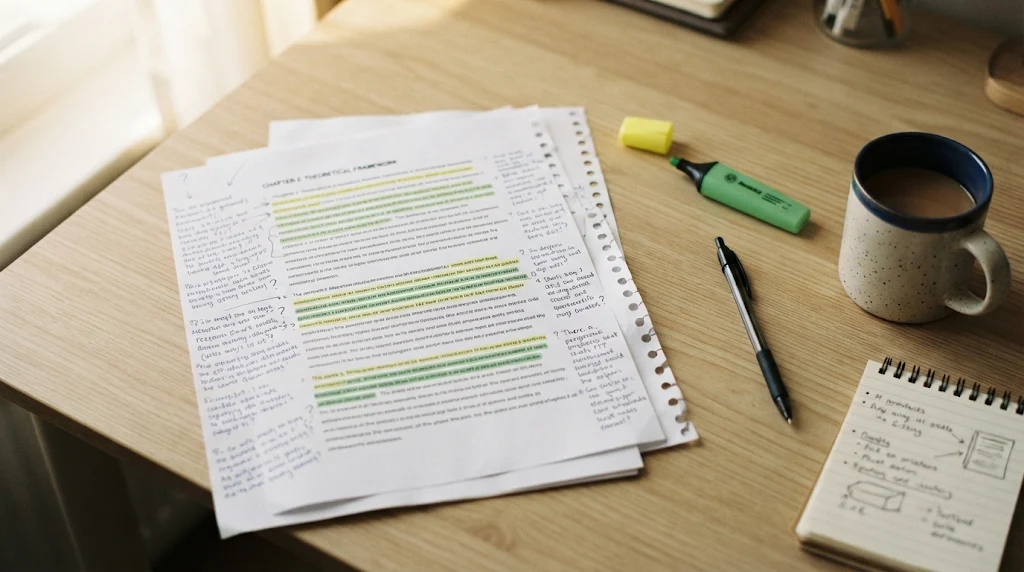
Print the draft and pick two colours. Use one for definitions, summaries and background. Use the other for passages where you compare views, assess evidence, question assumptions or explain why a finding matters.
There's no fixed ratio, because it depends on the task and level. But if an evaluative assignment has pages of background and almost no comparison or judgement, the discussion needs developing. Try asking "so what?" after every summary and write the answer down.
The reverse outline
This lets you examine structure without getting distracted by sentence-level problems. Beside each paragraph, write a short note on what it does, not what it says. A retention report might give you this:
- Introduces the retention problem
- Explains a motivation theory
- Presents organisational findings
- Discusses satisfaction factors
- Explains the same theory again
- Examines limitations
Now read only the notes. You may spot the same point appearing twice, an explanation arriving too late, or a paragraph that needs context the reader doesn't have yet. Those problems are hard to see in polished prose and obvious in a simple list.
Test your claims and your flow
Choose three important claims and take them one at a time. What exactly are you arguing? Which source supports it? Does that evidence genuinely justify your conclusion? A source can be relevant without supporting the specific claim you're making.
Generalising is the usual trap. Findings from one organisation may reflect its management structure or working conditions. Applying them to a whole industry makes the conclusion broader than the evidence allows. The same care applies to association and causation: satisfaction and productivity rising together doesn't prove one caused the other.
Then read the last line of one paragraph and the first line of the next. Does the second follow, or does the discussion lurch? Sometimes you move a paragraph. Sometimes one sentence explaining why the next point matters is enough.
Mistakes worth avoiding
- Rewriting everything. Usually only a few sections need work. Find the source before you bin the lot.
- Deleting all background. Some description helps. Keep what the argument needs.
- Sounding "academic" at all costs. Clear beats impressive.
- Adding citations instead of analysis. Often the missing piece is saying what the evidence shows.
- Treating the rubric as a checklist. Meeting each criterion is necessary, but the work still has to show how ideas connect and why conclusions are justified.
- Writing the conclusion first. It invites a verdict the evidence may not back.
Once the argument is settled, check headings, page numbers, figures (mentioned and interpreted in the text) and referencing, following your institution's guidance. Leave grammar until last. There's no point polishing a paragraph you'll later move or delete.
Final thought
A disorganised draft doesn't always need more research or more writing. It often needs a closer look at the purpose of each section, the evidence behind its main claims and the way one point leads into the next.
The aim isn't to make every paragraph sound impressive. It's to make each one contribute something, so the reader sees not only what you researched but how your evidence supports your answer.